Aave Files Emergency Motion to Free 30,766 ETH From NK Lawsuit

Aave LLC files an emergency motion in NY to vacate a $71M ETH restraining notice. Explore the legal fight over KelpDAO hack recovery funds.
Quick Take
Summary is AI generated, newsroom reviewed.
Aave LLC filed an emergency motion on May 5, 2026, to release 30,766 ETH frozen after the April 18 KelpDAO exploit.
The protocol argues that stolen assets do not become the legal property of the thief, rejecting DPRK creditor claims.
Aave warns that allowing third-party creditors to seize recovered funds would set a dangerous precedent for all DeFi security responses.
The motion seeks an expedited hearing to restore the rsETH peg and compensate victims stalled by the restraining notice.
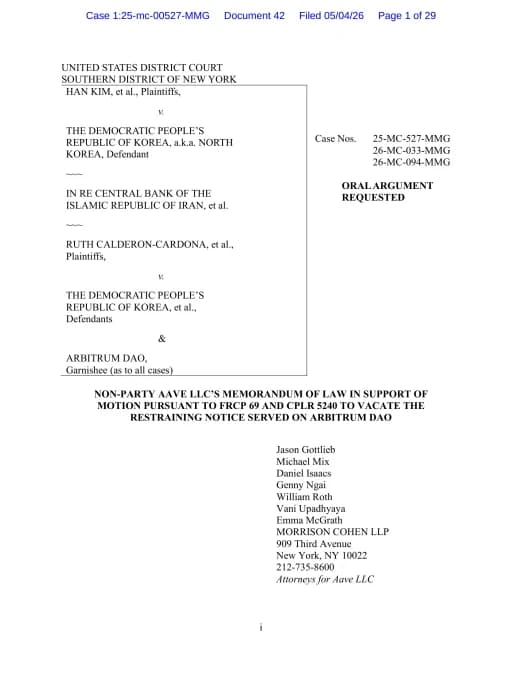
The legal battle over KelpDAO’s stolen funds just escalated sharply. Aave LLC has filed an emergency motion in a New York federal court to vacate the restraining notice that is blocking Arbitrum DAO from returning 30,766 ETH, roughly $71 million, to victims of the April 18 KelpDAO exploit.
AAVE FILES EMERGENCY MOTION TO FREE 30,000 ETH BLOCKED BY NORTH KOREA LAWSUIT
— BSCN (@BSCNews) May 5, 2026
Aave (@aave) has filed an emergency motion in a New York district court to vacate a restraining notice blocking Arbitrum DAO from transferring 30,766 Ether $ETH to victims of the Kelp exploit.
Law… pic.twitter.com/5v8unFOTQ4
The motion is direct and urgent. Aave is asking for an expedited hearing and immediate temporary relief. Aave news today puts one of DeFi’s most respected protocols at the center of a legal fight. This argument could reshape how U.S. courts handle stolen crypto forever.
The Core Legal Argument
Aave’s filing cuts straight to the point. Law firm Gerstein Harrow LLP argues that the Lazarus Group operates as a North Korean state-affiliated hacker unit. That carried out the KelpDAO hack, the frozen ETH qualifies as DPRK property. Under that theory, their clients’ decade-old judgments against North Korea entitle them to seize those funds.
Aave rejected that argument entirely. The filing uses a simple analogy to expose the flaw. Imagine a thief walks into Tiffany’s, smashes a jewelry case, and grabs three diamonds. A bystander intercepts the thief and recovers one diamond. Under Gerstein Harrow’s theory, the thief owns that recovered diamond, and the thief’s creditors can seize it from Tiffany’s.
Aave called that position one that “defies logic, common sense, and the law.”
In their public statement, Aave was equally blunt. “A thief does not gain lawful ownership of stolen property simply by taking it,” the protocol wrote. “Those assets were recovered to be returned to users victimized in the April 18, 2026 exploit. Freezing them harms the very people this recovery effort is designed to protect.”
What the Filing Actually Establishes?
Beyond the headline argument, Aave’s motion makes a precise legal case. Under CPLR 5222, a restraining notice is only valid if the restrained party actually holds property in which the judgment debtor has a legally recognized interest. Aave argues that North Korea has no such interest in the frozen ETH. Stolen property does not legally belong to the thief. Therefore, the restraining notice has no valid legal basis and must be vacated.
The filing also warns of cascading consequences. If this legal theory stands, every future DeFi recovery effort involving a state-sponsored hack becomes a target for unrelated creditors. That chilling effect could make protocols hesitant to freeze stolen funds at all, the opposite of what the industry needs.
What This Means for Investors and Developers
For Arbitrum and Aave investors, the immediate concern is resolution speed. Every day the ETH remains frozen, rsETH backing remains impaired and affected users stay uncompensated. An expedited hearing could unlock those funds quickly. A prolonged legal fight could drag on for months.
For developers, the precedent being set here matters enormously. If U.S. courts allow third-party creditors to intercept DeFi recovery funds based on unverified attribution to sanctioned actors, the entire framework for on-chain emergency responses becomes legally vulnerable. The Lazarus group connection here was based on, as Aave’s filing noted, “conjecture from posts on the internet.” That standard cannot become the basis for seizing victim funds.
References


Follow us on Google News
Get the latest crypto insights and updates.