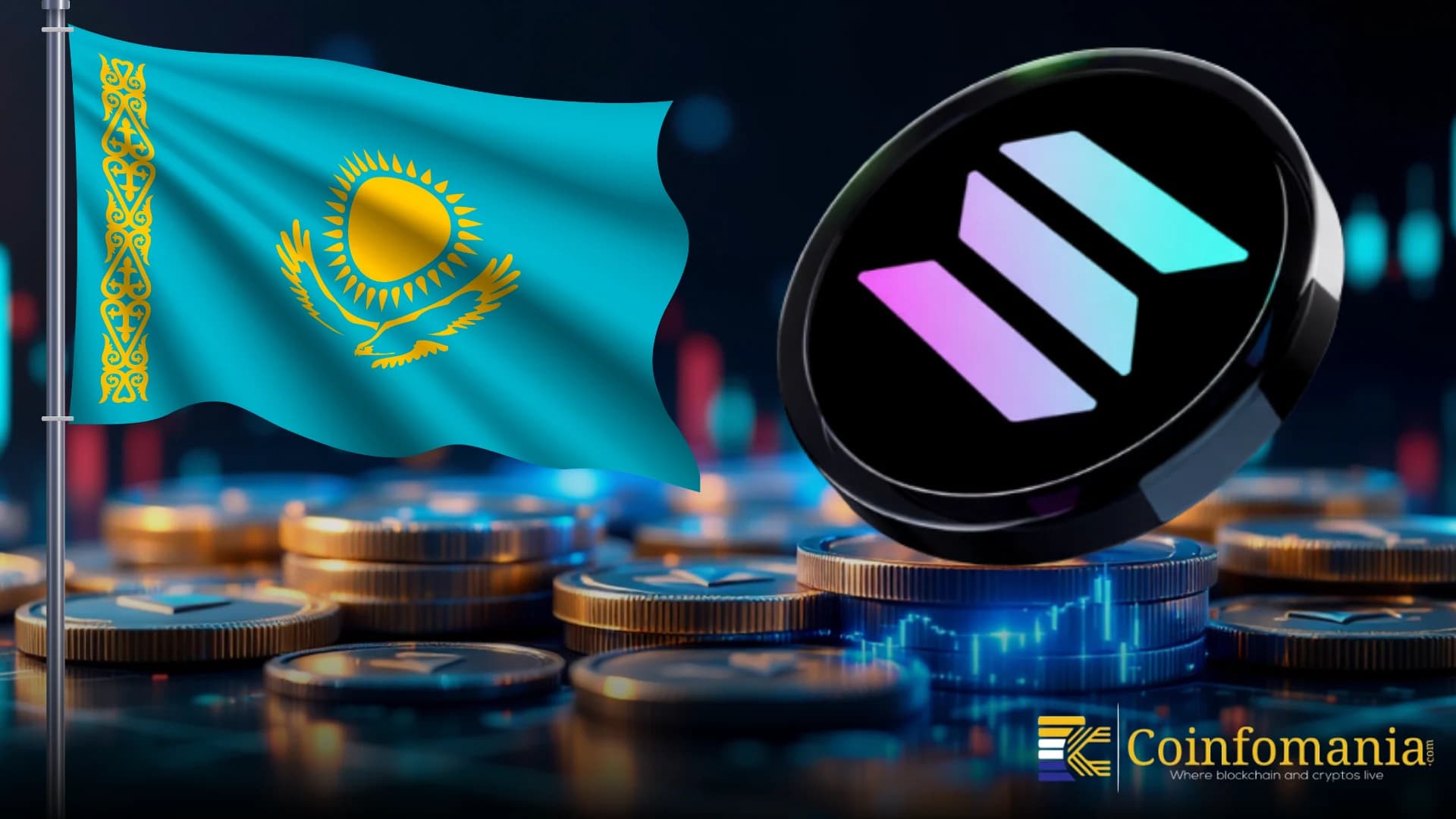
AirAsia MOVE Joins Solana to Launch Kazakhstan’s Stablecoin

AirAsia MOVE is integrating Solana-based KZTE stablecoin payments for 17M users. This partnership could reshape global payments.
Quick Take
Summary is AI generated, newsroom reviewed.
AirAsia MOVE is integrating KZTE — a Kazakhstani tenge-pegged stablecoin on Solana — into its travel app serving 17 million monthly users, covering flights, hotels, and ground transport by 2027.
Solana powers the backend — processing stablecoin settlements in under 400 milliseconds at fractions of a cent per transaction, making it the top Layer 1 for stablecoin volume in 2026 with over $1.2 trillion processed.
Mastercard bridges the gap — enabling KZTE-to-fiat conversion at point-of-sale terminals across Kazakhstan and ASEAN, so merchants never need to know they're accepting a stablecoin.
This sets an industry template — if successful, competitors like Booking.com, Grab, and Trip.com are expected to follow with similar stablecoin-on-Solana payment integrations within 12-18 months.
A single announcement just reshaped how millions of travelers might pay for flights, hotels, and ride-hailing across Southeast Asia and Central Asia. AirAsia MOVE, the super-app arm of Capital A, has partnered with the Solana Foundation and Kazakh fintech Intebix to bring a tenge-pegged stablecoin into its travel ecosystem. The deal signals something bigger than a crypto press release: it’s a real attempt to wire blockchain-based payments into the daily routines of 17 million active users, most of whom have never touched a crypto wallet. What makes this partnership unusual is the specificity. This isn’t a vague “exploring blockchain” memo. There’s a named stablecoin (Evo, ticker KZTE), a defined regulatory sandbox, a Mastercard integration plan, and a user base already transacting billions of dollars in travel bookings annually. If executed, it could become one of the largest real-world deployments of stablecoin travel payments anywhere on the planet.
BREAKING: @AirAsia MOVE, @Intebix, and Solana Foundation sign LOI to bring Evo (KZTE), Kazakhstan’s Tenge stablecoin, to Solana
Asia’s leading travel platform, connecting 17 million monthly users to 700 airlines and 1 million hotels worldwide. pic.twitter.com/yY6rDNXfOC— Solana (@solana) May 22, 2026
Breaking: AirAsia MOVE Integrates Kazakhstan’s First Tenge-Pegged Stablecoin
The deal, announced in Q1 2026, positions AirAsia MOVE as the first major travel super-app to accept a Central Asian stablecoin for cross-border payments. Evo (KZTE) is pegged 1:1 to the Kazakhstani tenge and built natively on the Solana blockchain. For AirAsia MOVE’s users, spread across Malaysia, Thailand, Indonesia, the Philippines, and now Kazakhstan, the stablecoin opens a payment rail that bypasses traditional correspondent banking and its associated fees.
The significance here isn’t just technical. Kazakhstan has been aggressively positioning itself as a crypto-friendly jurisdiction since 2023, and this partnership validates that strategy with a consumer-facing use case that goes well beyond speculative trading.
The Tripartite LOI: AirAsia MOVE, Intebix, and Solana Foundation
The letter of intent binds three distinct players, each contributing a critical piece. AirAsia MOVE brings distribution: 17 million monthly active users, an existing payments infrastructure, and a brand trusted across ASEAN. Intebix, the Kazakh fintech behind Evo (KZTE), provides the stablecoin itself, along with compliance infrastructure tailored to Kazakhstan’s regulatory environment. The Solana Foundation contributes the blockchain layer, developer support, and network effects from its growing stablecoin ecosystem.
What’s notable about the LOI structure is that it’s not a loose memorandum of understanding. Each party has skin in the game. Intebix needs a high-volume use case to prove KZTE’s viability. Solana needs real transaction throughput beyond DeFi. AirAsia MOVE needs lower payment processing costs on cross-border routes where card fees eat into thin margins.
Scaling to 17 Million Users: Travel Ecosystem Integration
AirAsia MOVE isn’t a niche crypto app. It processed over $4 billion in gross merchandise value across its travel verticals in 2025. Adding stablecoin payments to that flow means the blockchain layer has to be invisible to the average user. Nobody booking a Kuala Lumpur-to-Almaty flight wants to think about Solana block confirmations.
The integration plan reflects this reality. Users will see KZTE as just another payment option alongside credit cards, e-wallets, and bank transfers. Behind the scenes, Solana handles settlement in under 400 milliseconds, and the stablecoin conversion happens at the point of sale. AirAsia MOVE’s existing loyalty program, AirAsia Points, will reportedly be interoperable with KZTE, letting users earn and redeem across both systems. That interoperability is where the real stickiness lives.
Technical Infrastructure: Why Solana and Evo
Choosing a blockchain for high-volume consumer payments isn’t a branding exercise. It’s an engineering decision with direct consequences for user experience, cost, and reliability. The selection of Solana for this deployment tells us something about where the stablecoin payments space has moved in 2026.
Solana’s 2026 Dominance in Global Stablecoin Payment Volume
Solana now processes more stablecoin payment transactions than any other Layer 1 network. According to data from Artemis Analytics, Solana handled over $1.2 trillion in stablecoin transfer volume in 2025, surpassing Ethereum’s mainnet for the first time. The gap has widened in 2026, driven by sub-cent transaction fees and consistent sub-second finality.
For a travel app processing thousands of bookings per hour, these numbers matter concretely. When you multiply that across millions of monthly transactions, the savings are substantial. Solana’s Firedancer validator client, fully deployed in early 2026, has also improved network uptime to 99.95%, addressing the reliability concerns that dogged the chain in prior years.
Evo vs. Kazakhstan’s Crypto Card Pilots
Evo (KZTE) launched in mid-2025 within Kazakhstan’s Astana International Financial Centre (AIFC) regulatory perimeter. The stablecoin maintains its tenge peg through a reserve model backed by Kazakhstani government bonds and cash equivalents held in AIFC-licensed custodial accounts. Monthly attestation reports, published by a Big Four auditor, verify that reserves match or exceed circulating supply.
The peg has held within a 0.3% band since launch, even during periods of tenge volatility against the dollar. That stability is partly structural: KZTE’s mint-and-burn mechanism allows authorized participants to create or redeem tokens at par, keeping arbitrage opportunities tight. For AirAsia MOVE, this means pricing travel services in KZTE carries minimal currency risk compared to accepting volatile crypto assets. The stablecoin effectively functions as a digital version of the tenge, with the added benefit of programmable settlement. Evo doesn’t exist in isolation. The NBK sandbox also includes crypto card pilots launched in June 2025, where Mastercard-linked cards allow users to spend USDT (and other stablecoins) via instant KZT conversion at the point of sale. The relationship between the two is synergistic, not competitive:
| Feature | Crypto Cards | Evo (KZTE) |
|---|---|---|
| Form | Payment instrument (card) | Native on-chain stablecoin |
| Backing | USDT → auto-converted to KZT | 1:1 KZT fiat reserves |
| Primary Use | Everyday retail spending | Payments, DeFi, cross-border, travel |
| Tech Layer | Card rails + wallet linkage | Solana blockchain |
Regulatory Framework and the National Bank of Kazakhstan Sandbox
Kazakhstan’s approach to crypto regulation has been unusually deliberate. Rather than blanket bans or permissive free-for-alls, the National Bank of Kazakhstan (NBK) established a regulatory sandbox within the AIFC in 2024, specifically designed for stablecoin issuance and digital asset payments. Intebix operates under this sandbox, which imposes requirements around reserve transparency, anti-money laundering controls, and consumer protection.
The sandbox framework gives AirAsia MOVE something rare in the crypto-travel space: regulatory clarity. The company isn’t operating in a gray zone. KZTE is a sanctioned instrument within a defined legal framework, which reduces compliance risk for a publicly listed parent company like Capital A. Kazakhstan’s crypto regulation model has drawn attention from other Central Asian nations, with Uzbekistan and Kyrgyzstan reportedly studying similar sandbox structures for their own stablecoin initiatives.
Mastercard’s Role in Bridging Fiat and Digital Assets
Mastercard’s involvement adds a critical bridge between the stablecoin ecosystem and traditional payment infrastructure. Under the partnership’s terms, Mastercard will enable KZTE-to-fiat off-ramps at point-of-sale terminals across Kazakhstan and selected ASEAN markets. This means a traveler holding KZTE can spend at merchants who have no idea they’re accepting a stablecoin: the conversion to local fiat happens at the network level.
Mastercard has been building its crypto-to-fiat settlement capabilities since 2023, and this deployment represents one of its first integrations with a non-dollar stablecoin. The card network’s participation also provides a trust signal for merchants and regulators who might otherwise hesitate to engage with blockchain-based payments. For the end user, the Mastercard layer means KZTE isn’t trapped inside the AirAsia MOVE app. It becomes spendable anywhere Mastercard is accepted, which dramatically increases its utility.
Economic Impact on the Global Crypto-Travel Market
The travel industry processes roughly $9.5 trillion in annual transactions globally, and payment friction remains one of its biggest cost centers. Cross-border card transactions typically carry fees of 2.5% to 3.5%, and currency conversion adds another 1% to 2%. For a budget airline like AirAsia, where average ticket prices hover around $50 to $80, those percentages represent real margin pressure.
Stablecoin payments on Solana reduce settlement costs by an order of magnitude. If even 10% of AirAsia MOVE’s transactions shift to KZTE within the first year, the savings could exceed $15 million annually. That’s money that can flow back to consumers as lower fares or to the company as improved operating margin.
The broader signal is equally important. AirAsia MOVE’s integration creates a template that other travel platforms can replicate. Booking.com, Trip.com, and Grab have all explored crypto payment options, but none have committed to a specific stablecoin on a specific chain with a specific regulatory framework. This partnership sets a benchmark. If it works, expect similar announcements from competitors within 12 to 18 months, likely involving dollar- or euro-pegged stablecoins on Solana or competing chains.
Future Outlook: The Roadmap for Borderless Web3 Payments
The AirAsia MOVE and Solana partnership with Intebix is best understood not as a single product launch but as infrastructure for a broader shift. The roadmap shared during the LOI announcement outlines three phases: flight payment integration by Q4 2026, hotel and ground transport by Q2 2027, and a full Web3 loyalty and rewards layer by late 2027. That third phase is where things get genuinely interesting, because it implies on-chain loyalty points, composable rewards across partner merchants, and potentially tokenized travel packages.
The bigger question is whether this model can scale beyond Kazakhstan. AirAsia MOVE operates across six countries, each with distinct regulatory environments. Replicating the KZTE model would require stablecoins pegged to the Thai baht, Malaysian ringgit, Indonesian rupiah, and Philippine peso, each with its own reserve structure and regulatory approval. That’s a multi-year effort, but the Kazakh deployment serves as a proof of concept.
For travelers, the promise is simple: lower fees, faster settlements, and a payment method that works the same whether you’re booking from Almaty or Manila. For the industry, this is a real test of whether stablecoin payments can move from crypto-native niches into mainstream commerce. The next 18 months will determine whether AirAsia MOVE’s bet on Solana-based stablecoin payments becomes a model for the industry or remains an interesting experiment in Central Asia. Either way, the pieces are now in place for something the travel sector hasn’t seen before: blockchain infrastructure that users never have to think about, doing real work at real scale.
References


Follow us on Google News
Get the latest crypto insights and updates.