Korean Won Now Drives 30% of Global Crypto Trading in 2026

South Korean won captures 30% of global crypto spot volume in 2026, trailing only the USD. Explore the retail-driven altcoin boom.

Quick Take
Summary is AI generated, newsroom reviewed.
Korean won pairs now account for 30% of global spot volume, with altcoins making up 85% of domestic activity.
Weekly turnover reaches $26 billion across Upbit and Bithumb, though Bitcoin market depth remains thinner than in Japan.
The crypto surge parallels a 69% YTD rally in the iShares MSCI South Korea ETF, fueled by AI chip leaders Samsung and SK Hynix.
High retail risk appetite is linked to tech sector confidence, with 40% of local altcoin holdings currently at all-time lows.
South Korea is not just participating in global crypto markets. It is moving them. Korean won pairs now account for 30% of all global spot crypto volume in 2026, according to research firm Kaiko. With $26 billion in weekly turnover and 52 million people fueling the activity. South Korea ranks second only to the US dollar markets in scale. For crypto market news, that is not a footnote. That is a structural reality reshaping how altcoins trade globally.
The Numbers Behind Korea’s Dominance
The composition of Korean trading tells an even more striking story. Altcoins represent 85% of all domestic crypto activity. Bitcoin accounts for just 9%. Ethereum sits at 6%. That breakdown is almost the inverse of what most Western markets show.
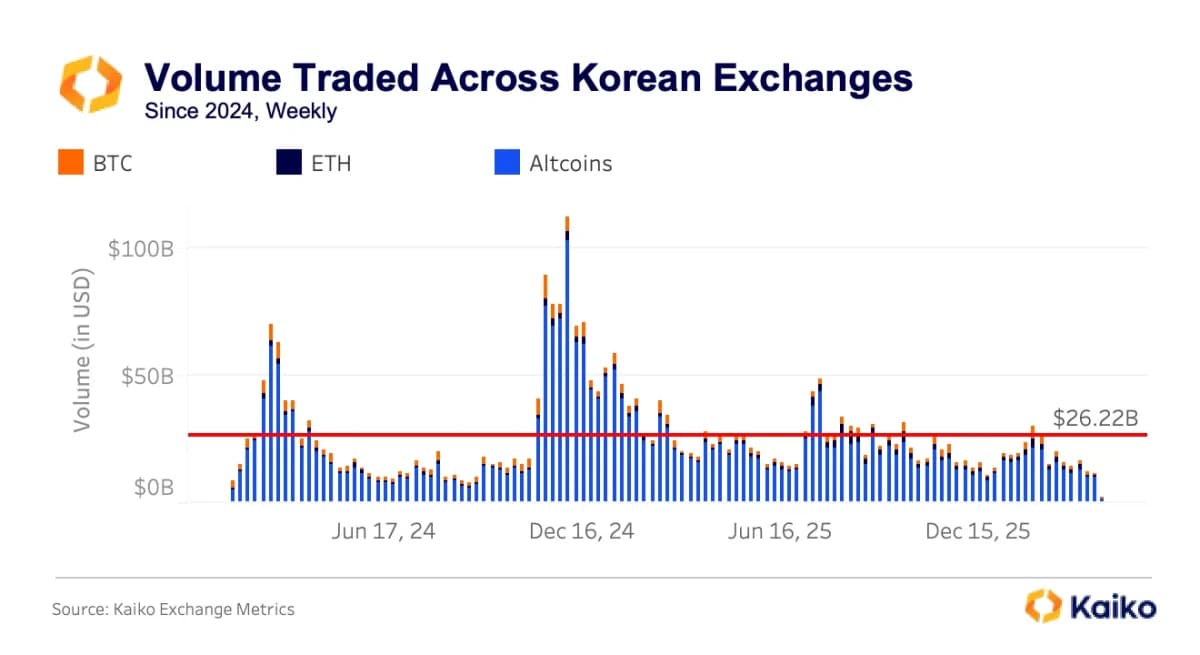
Source: Kaiko Exchange Metrics – Volume Traded Across Korean Exchanges (Weekly, Since 2024)
Upbit and Bithumb handle the overwhelming majority of this volume. Together, these two exchanges process most of Korea’s $26 billion weekly average. Based on Kaiko data tracked from 2024 through 2026. Upbit BTC KRW market depth sits at roughly $1 million to $1.2 million, functional but thin for the volume passing through it.
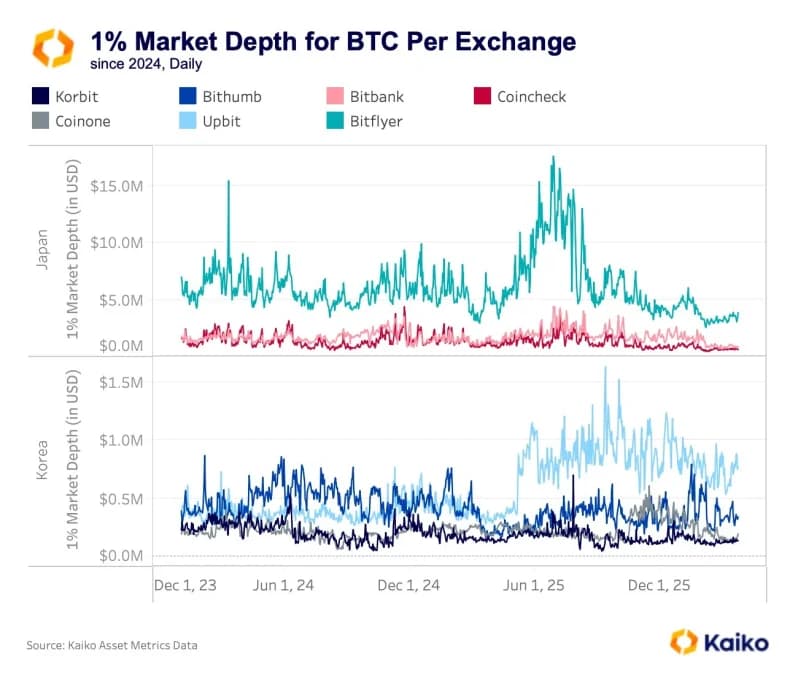
Source: Kaiko Asset Metrics Data – 1% Market Depth for BTC Per Exchange (Daily, Since 2024)
The contrast with Japan is sharp. Yen-denominated trading runs at just $2 billion to $3 billion monthly across four exchanges. But Japan’s Bitcoin market depth is 3x to 5x deeper than Korea’s. Tokyo-based Bitflyer alone holds around $3.5 million across its order books.
Kaiko summarized it directly. “While South Korea accounts for a large share of the global market in terms of trading volume, Japan has a more stable structure in terms of Bitcoin liquidity.”
What Is Driving Korean Retail Into Crypto
Korea’s crypto boom does not exist in isolation. It runs alongside a parallel rally in Korean tech equities. The iShares MSCI South Korea ETF returned over 37% year-to-date through March 2026. It is driven by Samsung Electronics and SK Hynix. This together represents roughly 45% of the fund’s holdings. Both companies dominate the global supply of high-bandwidth memory chips, the critical component powering AI training systems worldwide.
As AI infrastructure spending accelerates, Korean industrial output sits at the center of every major data center expansion this cycle. One analyst described the dynamic bluntly. “This isn’t really a Korea bet; it’s a leveraged AI bet through a different door.” That same risk appetite flows directly into crypto venues. When retail confidence runs high on tech earnings. Korean traders historically rotate into high-volatility altcoins aggressively.
What This Means for Investors
For crypto exchange news watchers and global investors, South Korea’s 30% share of spot volume of Korean won means one thing practically: Korean retail moves altcoin prices. When Upbit lists a token or volume spikes on Bithumb, global prices follow. Notably, around 40% of altcoins held by Korean investors are currently trading at all-time lows. It is exceeding even the 37.8% recorded immediately after FTX’s collapse in 2022. That is a risk indicator worth watching closely.
The durability of Korea’s crypto dominance through 2026 will depend heavily on Samsung and SK Hynix’s Q2 earnings. The AI memory cycle that powers Korean equities is the same cycle feeding retail crypto appetite. Watch those results carefully.
References


Follow us on Google News
Get the latest crypto insights and updates.
Related Posts

Beyond the Headlines: Why CryptoKaleo’s Bitcoin Speculation Matters — What Comes Next

Vandit Grover
Author
DaanCrypto Highlights Bitcoin’s Stagnation as Market Sentiment Shifts — What This Means for Investors
Vandit Grover
Author
Why Bitcoin Just Saw a Surge in Whale Activity — The Takeaway for Crypto
Vandit Grover
Author