U.S. Approves Alibaba and Tencent to Buy Nvidia H200 AI Chips

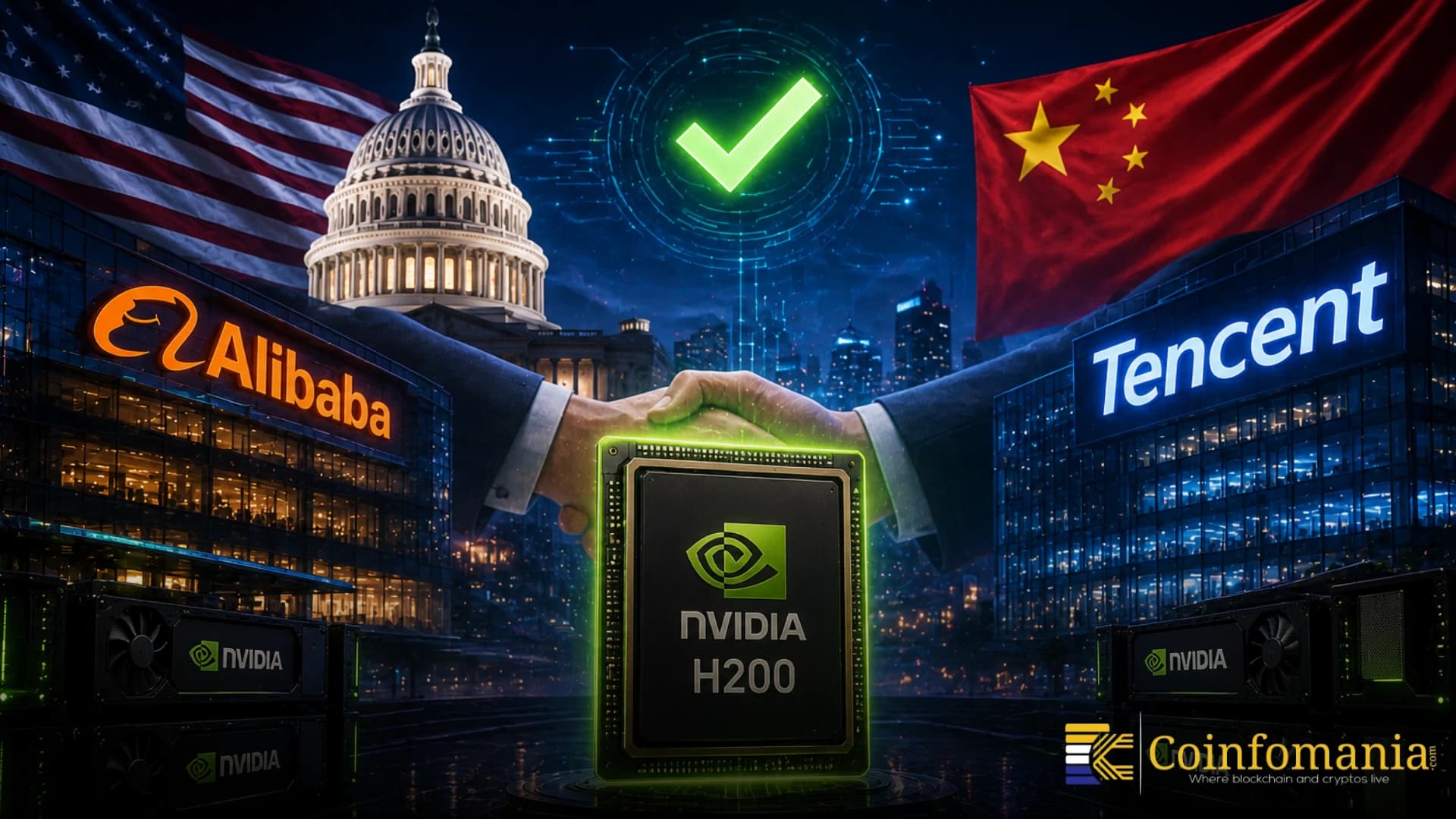
The U.S. approves Alibaba and Tencent to purchase Nvidia H200 AI chips, shifting export policies amid China's domestic push.
Quick Take
Summary is AI generated, newsroom reviewed.
Alibaba, Tencent, and ByteDance were approved to buy up to 75,000 H200 chips each under strict U.S. oversight.
Shipments remain frozen as Beijing pressures domestic firms to prioritize Huawei and other local AI hardware alternatives.
Licensing terms include a 25% revenue share for U.S. agreements and mandatory routing of hardware through U.S. territory.
Tightened global GPU supply could increase operational costs for decentralized AI networks and miners pivoting to HPC hosting.
The United States has approved several major Chinese technology companies. In process to purchase advanced Nvidia H200 AI chips under a tightly controlled licensing system. The approved buyers reportedly include Alibaba, Tencent, ByteDance, and JD.com. Alongside distributors such as Lenovo and Foxconn.
$NVDA is up almost 3% overnight because guidance provided in the previous quarters included $0 in China revenue.
— Sam Badawi (@Sam_Badawi) May 14, 2026
Jensen Huang just unlocked potentially $20B of new revenue in sales to $BABA, $JD, and other companies in $KWEB China Tech ETF.
Time for $250. https://t.co/E9V8mMiel5 pic.twitter.com/6oShhNVFTJ
The move marks one of the biggest shifts in U.S.-China AI trade policy since export restrictions tightened during the Biden administration. According to reports, each approved company can buy up to 75,000 H200 chips. Although no shipments have been delivered yet because Beijing is encouraging firms to prioritize domestic AI hardware instead. The development is already driving fresh conversation across both the AI and crypto sectors. Especially as Nvidia shares climbed nearly 2% following the news.
What Makes Nvidia’s H200 Chips So Important?
The H200 is Nvidia’s second-most powerful AI chip based on the Hopper architecture. It is built for training and running large AI models at scale. Each Nvidia H200 GPU includes 141GB of HBM3e memory and is widely used for generative AI workloads, cloud infrastructure, and enterprise AI applications. Current estimates place the Nvidia H200 Price between $30,000 and $40,000 per GPU. Rental access can cost between $3.72 and $10.60 per hour depending on compute providers.
Under the new licensing terms, approved Chinese buyers must follow several restrictions:
- No military use
- Hardware routing through U.S. territory
- Proof of security controls
- A reported 25% revenue share tied to U.S. agreements
Despite the approvals, Chinese firms have reportedly paused purchases. After guidance from Beijing pushed companies toward domestic alternatives like Huawei AI chips. That means the headline is massive politically but commercially, deliveries still remain frozen for now.
Why This Matters for Nvidia and China
For Nvidia, the policy shift could reopen a market that once represented a major share of company revenue. Before export restrictions, Nvidia reportedly controlled about 95% of China’s advanced AI accelerator market. China previously accounted for roughly 13% of Nvidia revenue at its peak. Now, the reopening of sales to firms like Alibaba and Tencent could eventually unlock billions in additional revenue if shipments move forward.
This also explains why Nvidia News Today quickly became one of the hottest topics across financial markets. However, the decision is politically sensitive. Critics inside Washington argue that easing restrictions could accelerate China’s AI capabilities. Meanwhile, Chinese regulators are trying to reduce dependence on foreign chips entirely. So while the approval eases tensions temporarily, the larger U.S.-China AI competition is far from over.
How This Could Affect Crypto Investors and Developers
Although this is mainly an AI infrastructure story, it could still create ripple effects across crypto markets. First, stronger demand for H200 chips could tighten global GPU supply. That may increase costs for decentralized AI networks and GPU rental projects connected to crypto ecosystems. Projects tied to decentralized compute, including AI-focused blockchain infrastructure. That could face higher hardware expenses or longer wait times.
Second, some Bitcoin miners expanding into AI and HPC hosting may benefit long term if global AI demand keeps rising. Several mining companies have already started diversifying into AI data center services instead of relying only on mining revenue. However, smaller AI-hosting crypto firms could face margin pressure if GPU cloud prices increase further.
For developers, the impact is more indirect. H200 chips are optimized for AI workloads, not traditional crypto mining. Still, stronger AI infrastructure in China could accelerate development around AI agents, zero-knowledge systems, decentralized compute, and blockchain automation tools. At the same time, U.S. export controls still block China from accessing Nvidia’s most advanced AI hardware.
Nvidia’s China Comeback Still Faces Big Obstacles
The approval of H200 Chips To China is a major policy shift, but it does not guarantee immediate sales. Beijing’s push for domestic chip independence remains a major barrier. Chinese firms are increasingly investing in local AI infrastructure rather than depending on U.S. technology suppliers. Still, investors are closely watching whether these approvals eventually turn into real shipments. For now, the news gives Nvidia a potential path back into one of the world’s largest AI markets. While also reminds the industry that the AI race is becoming just as geopolitical as it is technological.


Follow us on Google News
Get the latest crypto insights and updates.